
Britain may not have tropical rainforests or vast deserts, but it possesses something equally remarkable: an incredibly rich and often overlooked fungal kingdom.
From woodlands and meadows to parks and gardens, thousands of fungal species emerge throughout the year. Many appear only briefly, transforming the landscape before disappearing once again.
Let’s explore some of Britain’s most recognisable mushrooms and discover why fungi are among the most important organisms in nature.
Fly Agaric: The Storybook Mushroom
If somebody asked you to draw a mushroom, chances are you’d sketch a red cap covered in white spots.
That’s the Fly Agaric (Amanita muscaria).
This striking fungus appears throughout Britain during autumn and has inspired countless fairy tales, folklore illustrations, fantasy artwork and video games.
Despite its charming appearance, Fly Agaric contains psychoactive compounds and should never be eaten casually.
Its vivid colours may act as a warning signal, much like bright colours found in certain poisonous animals.
You can learn more about fungal biology and identification through our article on DNA Barcoding Fungi.
Field Mushroom: The Wild Relative
The Field Mushroom (Agaricus campestris) is one of Britain’s best-known wild fungi.
Often found in meadows and grazing land, it closely resembles the mushrooms sold in supermarkets.
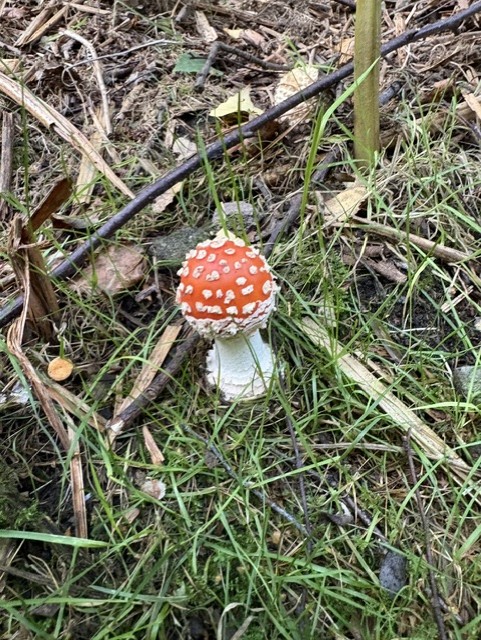
A member of the Agaricus group, one of Britain’s most recognisable mushroom genera.
Historically, field mushrooms have been widely collected for food. However, accurate identification is essential because several toxic species can appear superficially similar.
This is one reason modern foraging experts place such an emphasis on training and species identification.
Shaggy Inkcap: Nature’s Self-Destructing Mushroom
The Shaggy Inkcap (Coprinus comatus) is one of Britain’s strangest fungi.
At first it appears as an elegant white cylinder covered in shaggy scales. But within days it begins an extraordinary transformation.
The cap literally dissolves into a black liquid rich in spores.
This process, known as autodigestion, allows the fungus to maximise spore dispersal and has fascinated naturalists for centuries.
Few British fungi demonstrate the incredible diversity of fungal reproduction quite so dramatically.
Turkey Tail: A Woodland Workhorse
Unlike traditional mushrooms, Turkey Tail (Trametes versicolor) grows as colourful layered brackets attached to dead wood.
Named for its resemblance to a turkey’s tail feathers, it is one of Britain’s most widespread woodland fungi.
Turkey Tail plays a vital ecological role by breaking down wood and recycling nutrients back into forest ecosystems.
Without fungi like this, woodland habitats would struggle to process fallen branches and dead trees efficiently.
Common Puffball: Nature’s Smoke Bomb
The Common Puffball (Lycoperdon perlatum) doesn’t look much like a typical mushroom at all.
Its rounded fruiting body stores millions of spores inside a protective shell.
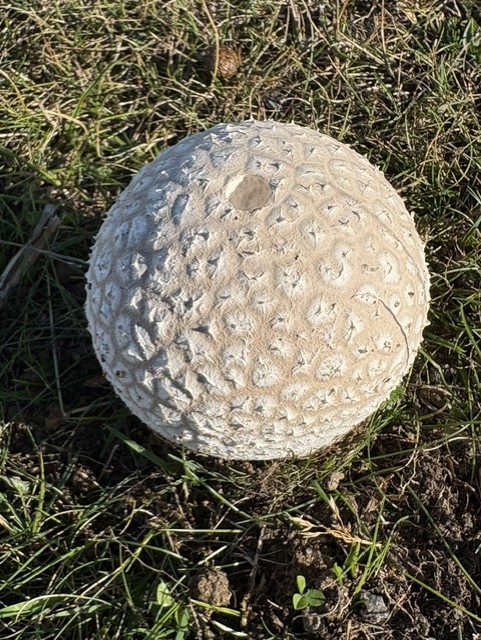
Puffball fungi release vast clouds of spores when disturbed by rain, animals or passing wildlife.
As the puffball matures, a small opening develops at the top.
Pressure from raindrops, animals or even curious fingers can release dramatic clouds of spores into the air.
Each cloud represents the fungus sending its offspring into the surrounding landscape.
Fairy Ring Champignon
The Fairy Ring Champignon (Marasmius oreades) is famous for creating circular formations known as fairy rings.
These rings inspired centuries of folklore, with many people believing they marked places where fairies gathered and danced under moonlight.
Today scientists know these formations are created by expanding underground networks of mycelium.
You can learn more about these fascinating formations in our article exploring what fairy rings are and how they form.
Sulphur Tuft
The Sulphur Tuft (Hypholoma fasciculare) is a bright yellow woodland fungus often found growing in dense clusters on decaying wood.
Its vivid appearance makes it easy to spot, but it is considered poisonous and should not be consumed.
This species highlights an important lesson: appearance alone is never a reliable guide to whether a mushroom is edible.
Wood Blewit
The Wood Blewit (Lepista nuda) is one of Britain’s most distinctive autumn fungi.
Recognisable by its attractive purple colouring, it appears in woodlands, compost heaps and leaf litter.
Its unusual colour often surprises people encountering it for the first time.
Jelly Ear
The Jelly Ear (Auricularia auricula-judae) has a unique gelatinous texture and ear-like appearance.
Commonly found on elder trees, this fungus remains one of Britain’s most recognisable woodland species.
Unlike many mushrooms, it can survive extended dry periods by shrivelling and then rehydrating when moisture returns.
Why So Many Mushrooms Appear in Autumn
Autumn provides ideal conditions for fungal growth.
- Falling leaves create fresh organic matter.
- Cooler temperatures reduce evaporation.
- Frequent rainfall provides essential moisture.
- Shorter days encourage many species to fruit.
Together, these conditions trigger mushroom production and spore release before winter arrives.
This is why woodlands often seem to explode with fungal life from September through November.
The Challenge of Mushroom Identification
While some mushrooms are easy to recognise, many species can appear remarkably similar.
Even experienced naturalists occasionally encounter specimens that require further investigation.
That’s where DNA-based analysis becomes valuable.
ChXout’s Fungi DNA Identification Service can help identify fungal specimens through molecular testing rather than relying on appearance alone.
You can also discover more about our work in wildlife genetics on the Research at ChXout page.
Final Thoughts
Britain’s mushrooms aren’t simply woodland decorations.
They’re recyclers, ecosystem engineers, ancient survivors and biological innovators.
The next time you’re walking through a woodland, park or meadow, slow down and look carefully.
You may discover a remarkable fungal kingdom quietly shaping the landscape beneath your feet.
Need Help Identifying a Mushroom?
Have you discovered a fungus that you can’t identify with confidence?
Our DNA-based fungi identification service helps citizen scientists, naturalists and researchers identify fungal specimens accurately.