
Meet the Bryophytes
Whilst many of us are familiar with the fungi, bryophytes often go unnoticed. This ancient class of non-vascular plants is made up of three contenders – mosses, liverworts and hornworts. Forming soft green layers upon the forest floor, rocks and tree trunks, these species are vital to building and maintaining a healthy ecosystem. However, due to their size, and subtle morphological features, species recognition has long been a challenge.
Consisting of over 20,000 species, it’s no wonder bryophytes can be hard to differentiate! DNA barcoding allows accurate species-level identification, with only the smallest amount of sample. It opens a new window of opportunity for foragers and scientists alike to delve deeper into the world of bryophytes.
Calypogeia muellerina under a microscope, by Loup-Anne via Wikimedia Commons, CC-BY-4.0
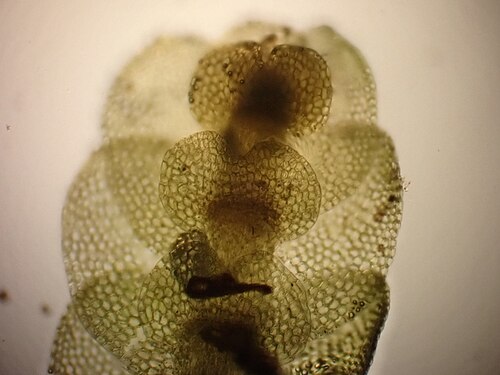
Liverworts, Hornworts and Mosses
These plants thrive where others cannot, colonizing a range of environments from bare rock to lush forest. Bryophytes are involved in primary succession and initiation of ecosystems, so must be hardy enough to survive in challenging conditions – see our earlier blog post on mosses and lichens to learn more about this! Liverwort Marchantia polymorpha is a classic example of this, helping to build the first layer of soil in newly exposed niches, by trapping dust and organic particles. Swan moss, or Mnium Hornum, is the UK’s most common moss, and often the first to grow in establishing environments.
Think of these pioneer species as a paint primer, preparing he surface before the final layers are added. They enrich and prepare the soil, prior to the ecosystem coming to life. The best soil can encourage the most diverse range of species to grow.
These mini architects are heavily involved in moisture regulation within ecosystems too, trapping and absorbing water for distribution. Liverwort’s thin, lobed bodies maximise surface area, an adaptation which makes them excellent at retaining moisture.
Hornworts share multiple similarities with mosses and liverworts, but their large chloroplasts set them apart. This allows them to efficiently pump organic matter into low-nutrient soils. As hornworts constantly release spores from their horn-like structures, they can rapidly cover large areas. New patches often crop up after spells of rain, with surface water carrying spores further afield. Field hornwort, or Anthoceros agrestis is widely spread across the Northern Hemisphere, so there is a good chance you have seen it before!
The DNA bit...
When carrying out species-level identification for fungi, scientists often target the Internal Transcribed Spacer (ITS) region. This acts as the universal fungal barcode and gives high resolution species matches across nearly all species. Commonly in bryophytes, chloroplast DNA is analysed. The rbcL gene reliably amplifies across most plant groups, and is recommended as the gold standard for plant ID. The matK gene may also be consulted if species are highly related, as it evolves more rapidly than rbcL, providing a slightly higher level of clarity.
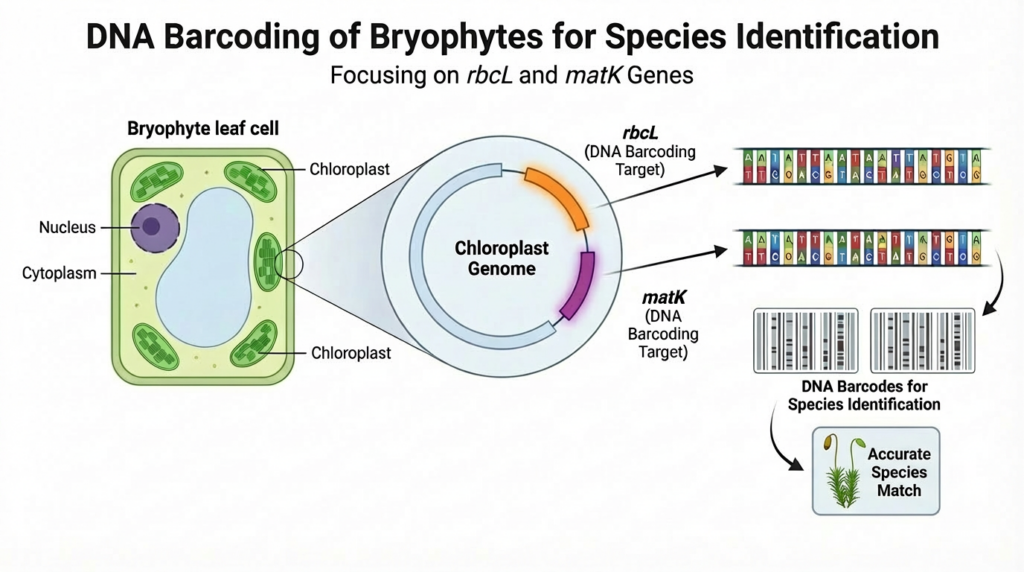
As well as quenching the curious forager’s thirst, DNA barcoding allows ecologists to assess biodiversity, with a greater level of understanding. Given their presence in sensitive habitats, bryophytes serve as environmental indicators of ecosystem health. Population fluctuations can be closely monitored, and with the worsening effects of climate change, is proving to be an invaluable tool. Despite their size, bryophytes form the foundations of many ecosystems, so disruptions here can have far-reaching impacts.
Through tracking populations with exactness, we can also ensure conservation efforts are channelled in the right direction. Conservationists can detect endangered or rare species, ensuring these are assisted first.