Hidden Heroes
Lichens and mosses make up some of the lesser noticed details of the forest. Growing quietly on stone walls, tree bark and exposed rock, they occupy a large range of ecological niches, supporting the ecosystem in some very unexpected ways. Acting as keystone species, entire ecosystem health can rely upon them, with removal having catastrophic effects.
Despite sharing morphological similarities and harmoniously growing side by side, these two organisms are very different, making species much trickier than it seems.
Both life forms play a pivotal role in primary succession, the earliest stage of ecosystem formation. Lichens break down rocks through chemical and physical means, this creates the first layers of soil in otherwise barren landscapes. This thin substrate is then colonised by mosses, stabilising and enriching conditions, encouraging new species to establish.
Lichens
Despite appearing as a single organism, lichens are a partnership between a fungus and a photosynthetic partner. The latter is usually a cyanobacteria or green algae. The thallus is the main body of the lichen, made mostly of the fungus, whilst the sugar-producing partner provides food.
Many lichens belong to the Ascomycota phylum and can be classified according to their fungal partner. This means we are readily able to identify these species using ITS1 and ITS4 primers, in a similar way as many other fungi. Common species such as Rhizocarpon geographicum (map lichen) and Cladonia rangiferina (reindeer lichen), typically resolve well with these primers.
Further classification of lichens arises from which algae they are associated with, for example ‘cyanophycophilous’ means with blue-green algae, whereas ‘chlorophycophilous’ denotes green algae only.
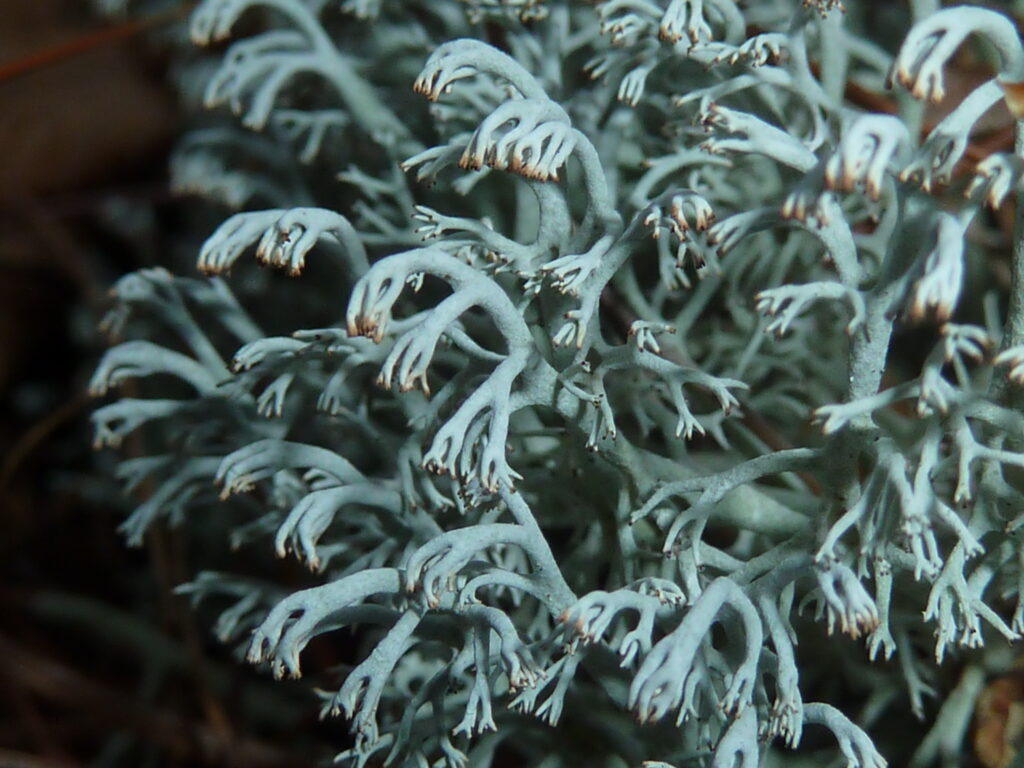
Pictured left is Reindeer lichen, and as the name suggests is a vital food source to Santa’s helpers, especially in barren landscapes like the Arctic tundra.
Cladina rangiferina, by Paul Morris, via Wikimedia Commons, CC BY-SA 2.0,
Mosses
Mosses on the other hand belong to the Bryophyta division, a group of non-vascular plants. They possess simple leaf-like structures, allowing photosynthesis and removing the need for a partner like a lichen. Mosses grow root-like filaments called rhizoids, anchoring them to the ground but not absorb nutrients.
The UK supports over 1000 known species of moss, making it exceptionally rich compared to the rest of Europe. Common species include Mnium hornum (Swan’s-neck) and Orthotrichum spp. (brittle mosses). During the identification process, the chloroplast (cpDNA) regions are often assessed. Genetic loci such as rbcL and rpoC1 provide high levels of distinction between closely related species. ITS1 and ITS4 regions occasionally provide a species match here, but due to the lack of a fungal counterpart, provide less consistent results.
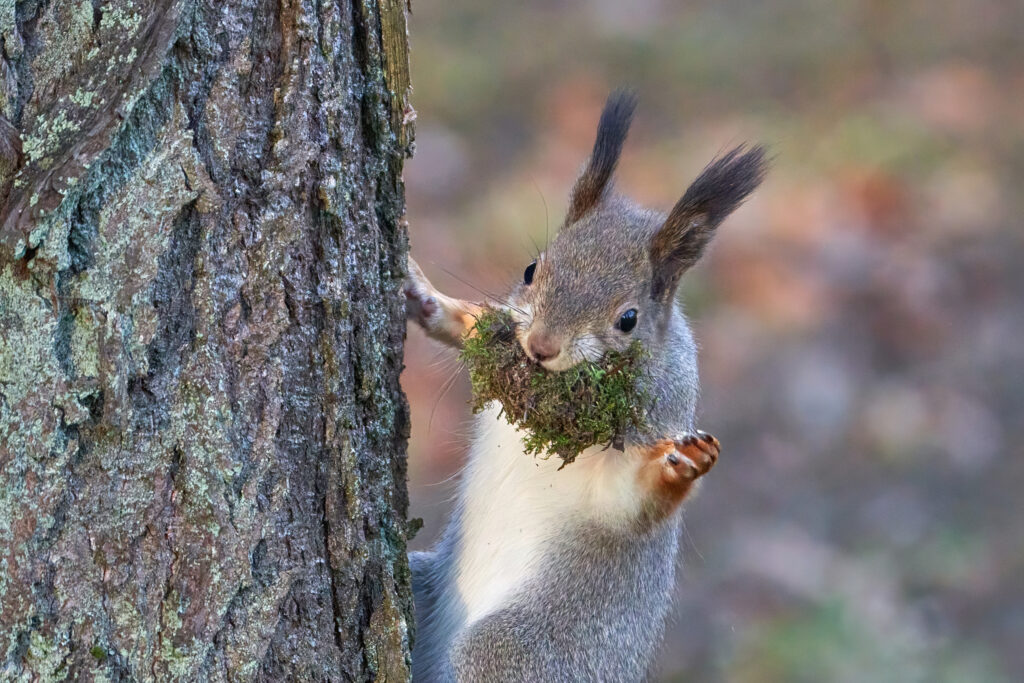
It’s not just lichens animals rely on, many species use mosses as nesting material or for food. Our little friend on the right is showing you just that!
Image by Andrey Gulivanov, via Wikimedia Commons, CC BY 2.0