
The Humble Bee
The UK is home to more than 250 species of bee, ranging from honeybees to bumblebees and the lesser-known solitary bees. Together they play an essential role in the maintenance of biodiversity and functioning of our ecosystems. Unfortunately, a combination of habitat loss, pesticides and climate change are contributing to the startling decline in our bee populations.
Understanding the humble bee’s role in our world is paramount to their protection. With such a diversity of species comes a wide range of specialities. However, many species appear remarkably similar, making it near impossible to differentiate between them. This is where species identification becomes crucial, allowing us to understand which species are present, and how to best protect them.
Become the Bee's Knees in Species ID...
Bumblebees, like Bombus terrestris are the classic fluffy fliers you know and love. With their thick fur coat they can fly in cooler, low light conditions. For this reason, they can kick-start pollination in early spring, when many species are not yet active. Bumblebees carry out pollination across wildflowers, and a few crops, but their special skill is buzz pollination. This technique is used on flowers which hide their pollen in poricidal anthers. Think of these as saltshakers with only one hole instead of many, effectively locking the pollen away. The bee buzzes, creating vibrations at a specific frequency, shaking the pollen free.
Apart from their fuzzy exteriors, the common Apis mellifera (honeybee) differs remarkably from the bumblebee. These slender bees are social creatures, existing in large colonies complete with a queen. These are the type of bees a beekeeper would likely keep as they produce a surplus of honey, a role often overshadowed when you consider how many fruits and vegetables they pollinate. Together this makes the honeybee vital to UK food security and agricultural trade.
Solitary bees, as the name suggests, are the lone wolves of the bee world. Species such as Osmia rufa, do not form colonies and nest in cavities, soil, or bee hotels – something we can all make at home to support populations! Despite making up around 90% of UK bee populations, many people do not know that they are professional pollinators. Unlike social bees, they lack a pollen basket, meaning when they visit a flower, a higher amount of pollen is dropped. A single Red Mason bee can pollinate the same amount as 120 honeybees in a single day! In comparison to their social counterparts, these bees tend to possess more distinctive markings and colourings, with varying levels of accompanying fluff!
The Great British Bee Problem...
Since WW2, the UK has lost 97% of its wildflower meadow. This is a real issue across all bee species, whose livelihoods depend upon it. Despite their considerable differences, this landform provides a source of nutrition and habitat for bees nationwide. This loss is accompanied by a rapid decline in many species, namely the Shrill carder bee (Bombus sylvarum). Accurate species-level identification allows scientists to track these declining populations, and direct conservation efforts to the species that need it most.
The ability to accurately identify a bee allows us to map the health of the ecosystem. Knowing what species are present allows us to understand what pollination is happening, or not, information which is important to not only ecologists but the UK economy. This knowledge can guide farmers and gardeners when deciding what plants and crops to grow, aiding conservation efforts.
In the likely event a bee cannot be identified through morphology alone, scientists turn to genetic markers to gain a highly accurate species match. Here DNA from the mitochondrial or nuclear regions is analysed, giving the ability to distinguish between closely related species. This tool is particularly valuable for solitary bees and closely related bumblebee species, where subtle traits make field identification tricky. A close-up analysis of DNA gives an objective solution to identification, ultimately helping protect our pollinators.
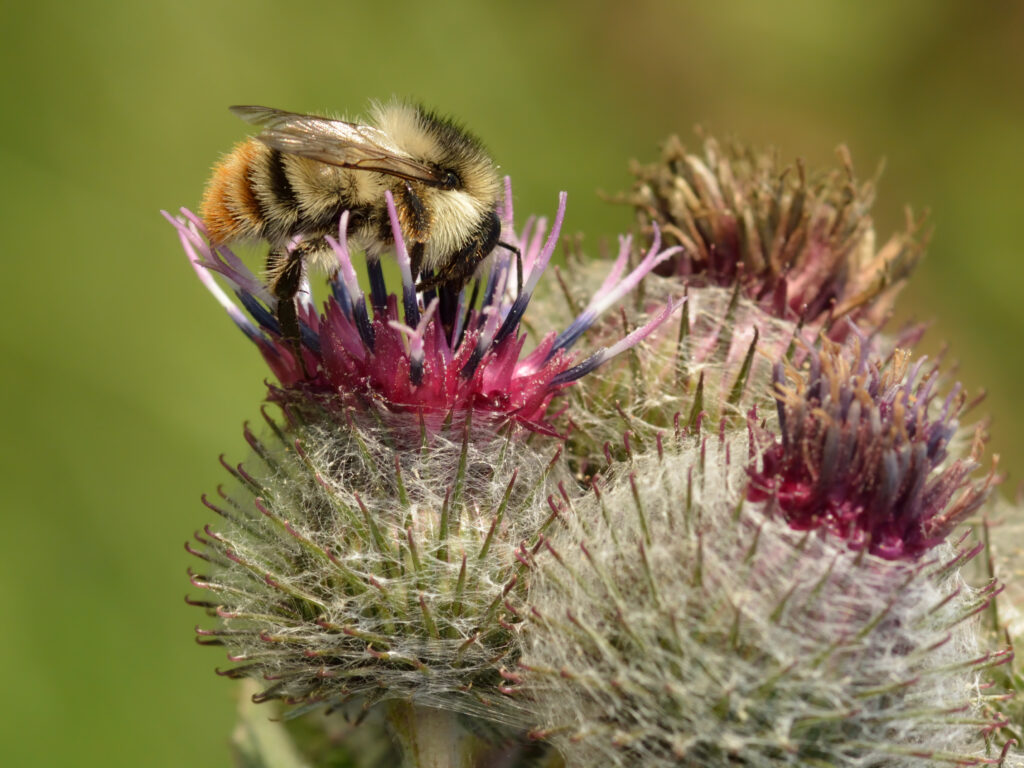
Bombus sylvarum, by Ivar Leidus, via Wikimedia Commons, CC BY-SA 4.0